Andrzej Strumiłło
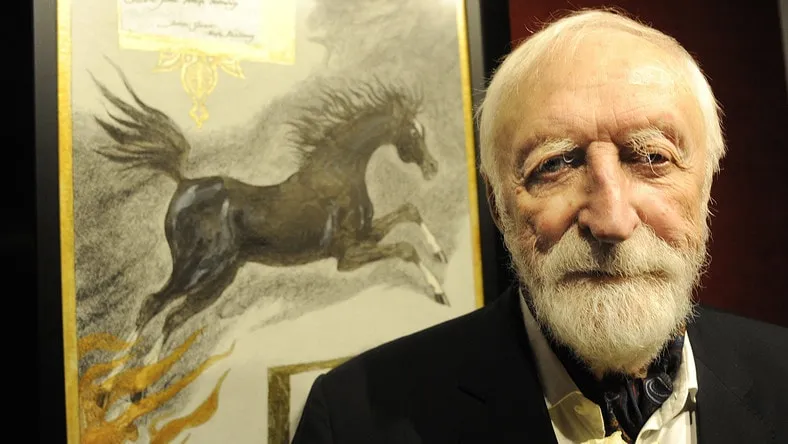
Andrzej Strumiłło - painter, draughtsman, photographer, sculptor, printmaker, poet and traveller, and an active campaigner for the development of culture and the protection of the landscape of north-eastern Poland. Equally important in his work were exhibition design (exhibition architecture and graphics), television and theatre set design, graphic design (he designed books, catalogues and posters), book illustration, essays and journalism.
He was interested in the arrangement of space (landscape design). Andrzej Strumiłło was also the initiator, organiser and curator of many exhibitions and plein-air workshops.
He was born on 23 October 1927 in Vilnius. In May 1945 he came to Łódź and began his studies at the State Higher School of Fine Arts (where Władysław Strzemiński taught), before transferring two years later to the Faculty of Painting at the Academy of Fine Arts in Kraków (diploma 1950). From 1949 to 1953 he was an assistant to E. Eibisch at the Academy of Fine Arts in Kraków, and at the same time, in the academic years 1951/1952 and 1952/1953, an assistant to T. Grygiel and A. Rychtarski at the State Higher School of Fine Arts in Łódź. In 1954 he held his first solo exhibition – at the Institute of Fine Arts in Beijing. In 1956 he moved to Warsaw and began working with the Polish Chamber of Commerce. In the years that followed he travelled to Nepal, India, Japan, Thailand and wartime Vietnam, and journeyed through Mongolia, China, Syria, Turkey, Siberia and the Caucasus. These travels yielded hundreds of drawings and thousands of photographs, notes, and acquisitions in the form of works of art and objects of material culture.
Cycles of drawings and photographs emerged, such as: China (1954 and 1961), Italy (1957), the Far East, USSR (1958), India (1959, 1970 and 1972), Mongolia (1967), Vietnam (1969, 1970, 1978), Nepal (1974, 1980), Japan and Thailand (1978). Many of the objects the artist brought back enriched the collections of Polish museums – especially the Asia and Pacific Museum in Warsaw and the Ethnographic Museum in Kraków. From 1977 to 1980 he was a contract professor at the Academy of Fine Arts in Kraków; he was one of the initiators and, from 1977, also the commissioner of the interdisciplinary Sztuka i środowisko (Art and Environment) meetings in Wigry, which resulted (besides exhibitions and publications) in programmes for the Wigry, Suwałki and Masurian Landscape Parks, and later for Wigry National Park and the Green Lungs of Poland Foundation. In 1982 he won an open competition for the post of head of the Graphic Presentation Unit of the UN Secretariat in New York – a design studio producing publications for the UN, UNESCO, FAO and UNICEF. After two years with the UN he returned to Warsaw and decided to settle in the countryside, on the Polish–Lithuanian border, close to Vilnius and to places that recalled the atmosphere of his childhood. He bought land in Maćkowa Ruda on the Czarna Hańcza river, built a larch-wood house, farmed the land and bred horses. He continued to work intensively – painting, writing, designing publications and stage sets (his last project was the set design for Orpheus and Eurydice at the Vilnius Opera, 2009); he took part in various ecological and cultural initiatives for the region, lectured at the Suwałki branch of the Academy of Catholic Theology (1987–1988), at Wszechnica Mazurska in Olecko (from the 1990s until 2008) and at Białystok University of Technology, and curated many international plein-air workshops for sculptors and painters.
He held more than a hundred solo exhibitions (of paintings, drawings and photographs) in Poland and abroad, including in: Warsaw, Wrocław, Kraków, Szczecin, Łódź, Katowice, Olsztyn, Elbląg, Toruń, Płock, Radom, Suwałki, Beijing, New Delhi, Ulaanbaatar, Hanoi, Kathmandu, Tokyo, Berlin, Bremen, Antwerp, Milan, Duisburg, Prague, Bratislava, Moscow, Leningrad, Vilnius, Kaunas, Druskininkai, Šiauliai (Lithuania), Yuzhno-Sakhalinsk, New York and Meadville (USA); he took part in a number of group exhibitions too large to establish (including those representing Polish art abroad), among others in: New York, Havana, Bielefeld, Edinburgh, Lisbon, Madrid, Rome, Genoa, Lyon, Düsseldorf, Hanover, Münster and Leverkusen, as well as at the São Paulo and Venice Biennales (where he also designed the Polish pavilion).
He was the author, co-author or illustrator of more than one hundred and fifty books (including popular-science publications), poetry collections and albums; among others, he was the author of four volumes of illustrated poetry: Moje (Wydawnictwo Literackie, Kraków 1970), Jak (Wydawnictwo Literackie, Kraków 1983), Ja (Oficyna Wydawnicza Stopka, Łomża 2010) and Ja 2 (Wydawnictwo Arkadia, Suwałki 2011), as well as the diaries Factum est. Dzienniki 1978 – 2006 (Oficyna Wydawnicza Stopka, Łomża 2008); he was one of the initiators of the publication – together with Cz. Miłosz and T. Venclova – and the author of the concept of Księga Wielkiego Księstwa Litewskiego (Ośrodek Pogranicze, Sejny 2009), a volume of essays (by twenty authors from Poland, Lithuania and Belarus) translated into Lithuanian, Belarusian and English.
The artist was, or still is, a member of: the Council for Culture and Art to the Minister of Culture and Art, the Board of the Polish Culture Foundation, the Provincial Nature Conservation Commission in Suwałki, the Scientific Council of Wigry National Park, the Councils of the Podlasie Museum in Białystok and the Asia and Pacific Museum in Warsaw, the Pogranicze Foundation in Sejny, the Chapter of the Golden Sceptre of Polish Culture, and the Artistic Council of SPAF.
Andrzej Strumiłło received many state decorations and awards for his artistic achievements, for promoting Polish culture abroad and for his public service, including: the Knight’s Cross of the Order of Polonia Restituta, the Officer’s Cross of the Order of Polonia Restituta, the Commander’s Cross of the Order of Polonia Restituta (1999), the Bundesverdienstkreuz (1999), the Gold Medal Gloria Artis (2005), the award of the Minister of Culture and Art (twice), the award of the Minister of Foreign Affairs, the City of Warsaw Award and the award of the Marshal of Podlaskie Voivodeship, as well as the titles of Meritorious for the City of Suwałki (2001), Honorary Citizen of the City of Suwałki (2002) and Honorary Ambassador of Podlasie Culture (2009).
In January 2004 he received the honorary Golden Keys award of Kurier Poranny, an expression of its readers’ recognition of his civic stance and many years of selfless work for the region and the country.
As part of its “Galeria Żywa” (Living Gallery) series, the National Museum in Kraków presented an exhibition of Andrzej Strumiłło’s paintings, sculptures and drawings in 2013.
He died on 9 April 2020.
Translated from Polish.